


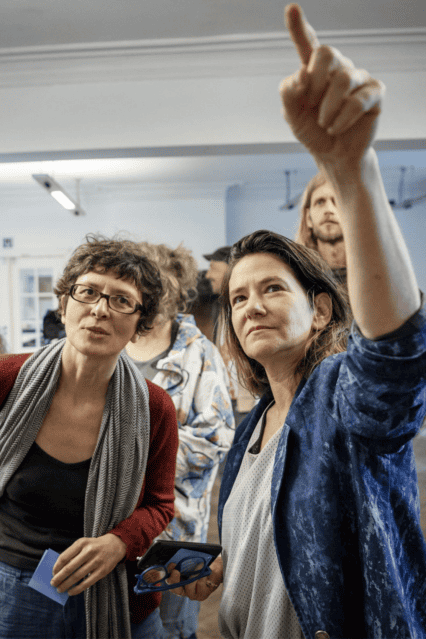
Socius, the support and expertise centre for civil society organizations in the field of culture based in Flanders and Brussels, is an autonomous organization subsidized by the Flemish Ministry of Culture.
Our main goal is to support and strengthen the civic organizations and professionals in their civic engagement, to maximise their impact for a democratic, inclusive, solidary, and sustainable society.
We offer our knowledge and expertise on several topics: organizational development, communication, working with citizen initiatives, diversity, voluntary work, and community development through a broad range of activities: training, workshops, inspiration days and network opportunities. We also offer tailor-made support and conduct research. We base our actions on the needs of our stakeholders but also assume a role of an inspirator, instigator and innovator.
Socius strives to form a link between civil society organizations in the field of culture and other sectors, education-, research- and the policy world and to ensure the visibility of civic professionals’ actions and commitments.
Our primary stakeholders are private civic initiatives organizing actions and activities meant for adult participants. They strive for social change and are formed by people in the social sphere separate from the state and the market. They are organized in many forms: associations, movements and training institutions, and work across different topics (sustainability, sharing economy, social and cultural participation, solidarity, human rights, identity) and through various actions (by connecting people and groups, by raising a critical voice, offering learning opportunities or experiment with new forms and ideas).
Our secondary stakeholders are governmental bodies, educators, and researchers from the relevant fields.
About socio-cultural work in Flanders & Brussels
How do socio-cultural organizations view society? How do they position themselves in that society? What ambitions do they have, and how do they plan to realize those ambitions?
You can learn more about the socio-cultural work with adults in the analysis ‘Ten Flows from Civil Society in Flanders and Brussels’.
Citizens make society
Every day, citizens around the world work to build a better future. They use the civil space to unite, make their voices heard and realise their social ambitions.
In the Flemish Community, too, citizens engage and unite voluntarily and on their own initiative. As elsewhere, they are driven by interests, values, beliefs and ambitions that they share and want to realise together. They tackle social issues, formulate proposals for the organisation of society and commit themselves to collective interests. Sometimes they
join one of the many socio-cultural organisations that Flanders and Brussels have to offer. Other times, they organise themselves into new citizens’ initiatives. Civil society provides these civil socio-cultural actors with an ideal place to participate and actively shape society.
What does this civil socio-cultural work look like today in the Flemish Community? Using recent research findings, we outline how socio-cultural organisations and citizens’ initiative operate in Flanders and Brussels today. They do so in a changing world.
Red flags for civil space in Flanders?
There are clear warning signs regarding the state of civic space in Belgium. These signals are visible both from the perspective of safeguarding fundamental rights − such as freedom of expression − and from the perspective of active subsidiarity. Polarisation and negative framing increase the associated risks. We also observe shifts toward the executive branch, which is increasingly concentrating decision-making power and, in doing so, reducing the implicit influence and voice of civil society organisations.
These tendencies prepare the public system for those who wish to govern in a more authoritarian manner. Based on our survey of Flemish civil society organisations, we find clear grounds for concern about the growing discourse aimed at restricting the space available to civil society in Belgium. It is therefore high time to make the quality of civic space in our country itself a subject of public debate and to continue monitoring it closely.
This longread was based on the publication ‘Safeguarding Civic Space for a Vital Democracy’ (‘De civiele ruimte vrijwaren voor een vitale democratie’), commissioned by Socius in May 2025.